
This article first appeared in the May/June issue of Arizona Contractor & Community.
View the full article as a PDF.
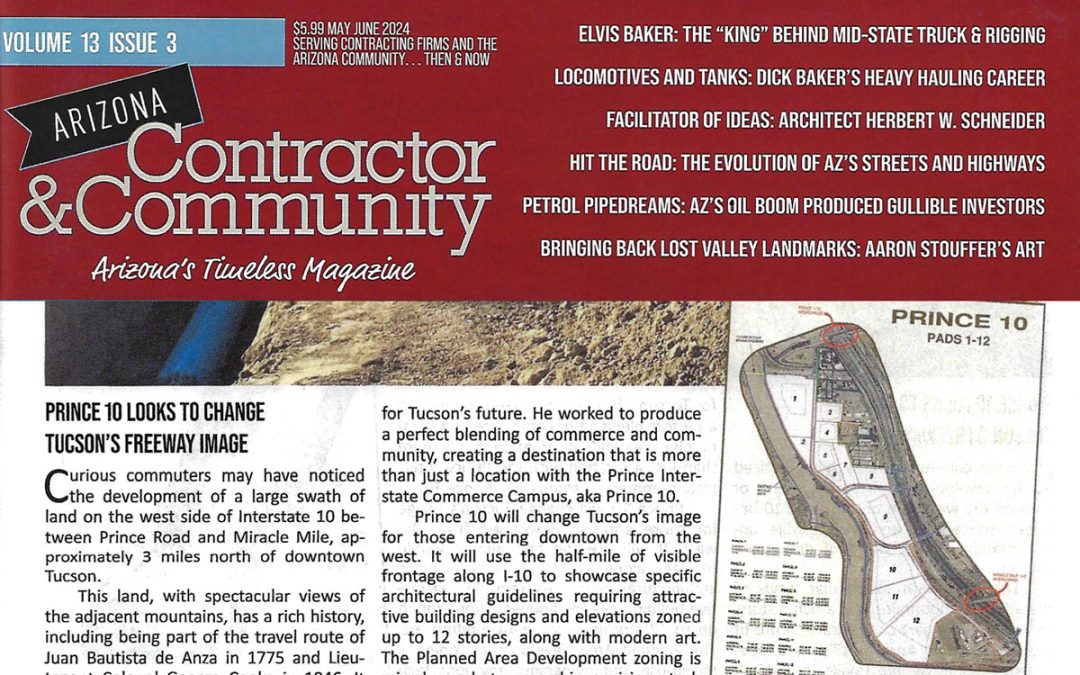
Curious commuters may have noticed the development of a large swath of land on the west side of Interstate 10 between Prince Road and Miracle Mile, approximately 3 miles north of downtown Tucson.
This land, with spectacular views of the adjacent mountains, has a rich history, including being part of the travel route of Juan Bautista de Anza in 1775 and Lieutenant Colonel George Cooke in 1846. It was later transformed into State Route 84, originating along the east bank of the Santa Cruz River at Miracle Mile and heading west towards Casa Grande.
The property’s new owner, Garry Brav, had this heritage in mind when he set to work on his vision to create a development for Tucson’s future. He worked to produce a perfect blending of commerce and community, creating a destination that is more than just a location with the Prince Interstate Commerce Campus, aka Prince 10.
Prince 10 will change Tucson’s image for those entering downtown from the west. It will use the half-mile of visible frontage along I-10 to showcase specific architectural guidelines requiring attractive building designs and elevations zoned up to 12 stories, along with modern art. The Planned Area Development zoning is mixed-use, but ownership envisions tech and manufacturing as the project’s focal point.
The development is a progressive, mixed-use, interstate commerce campus between Interstate 10 and the Santa Cruz River. Prince 10 comprises approximately 110 acres and features 12 development areas with the potential to accommodate high-tech industry and office buildings. Supplemental land uses may include hospitality, restaurants, other commercial uses, and multifamily housing.
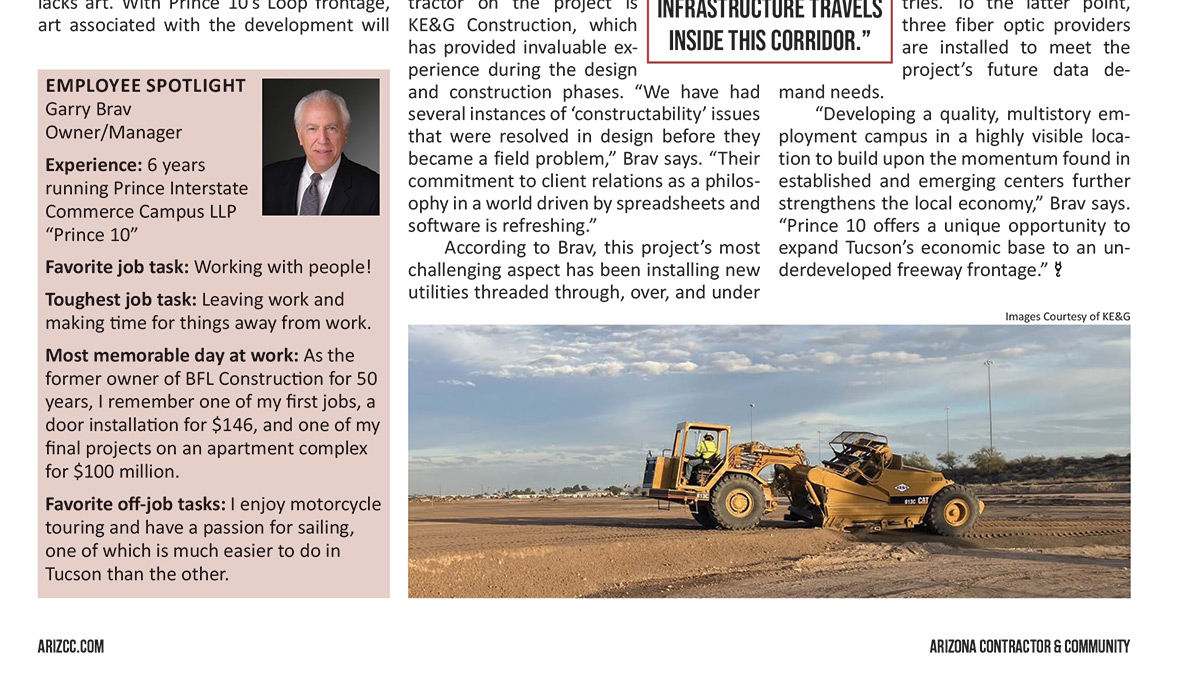
The Site Selector’s Guild, whose “members provide location strategy to corporations across the globe,” has specific criteria guidelines. Prince 10 meets its top two criteria by having shovel-ready land and direct freeway access. The former has been accomplished by grading, drainage, and utility improvements.
The project is located within two designated zones, including an Opportunity Zone (OZ), which offers potential tax savings for qualified investments, and a Justice 40 Zone, which qualifies for potential Department of Energy funds. Additionally, the City of Tucson has expanded its Central Business District to include Prince 10, which is a property tax-driven development incentive.
The site has convenient pedestrian access, with 1.25 miles of the Chuck Huckelberry Loop shared-use path along the Santa Cruz River. Incorporating artwork throughout the entire Loop network has been a tradition. Pima County has created an “Art on the Loop” map for self-guided tours.
Prince 10 occupies part of a 5-mile section of the Loop between Saint Mary’s Road and Ruthrauff Road, which currently lacks art. With Prince 10’s Loop frontage, art associated with the development will brighten this stretch along the Santa Cruz River and contribute to the Loop’s 131-mile open-space art gallery. “New public art installations bordering the west side of the development will help make Prince 10 a destination along the Loop,” Brav says.
A trailhead/bike park is in design within Prince 10, which includes a Culinary Bike Plaza providing restrooms, shelter, and food for recreational users of the Loop and the eventual employees of the Commerce Center. The owner is also working with the City of Tucson on a plan to provide housing for law enforcement officers and install a pedestrian bridge across the Santa Cruz River at the northern end of the project near the trailhead.
Prince 10’s prime contractor on the project is KE&G Construction, which has provided invaluable experience during the design and construction phases. “We have had several instances of ‘constructability’ issues that were resolved in design before they became a field problem,” Brav says. “Their commitment to client relations as a philosophy in a world driven by spreadsheets and software is refreshing.”
According to Brav, this project’s most challenging aspect has been installing new utilities threaded through, over, and under existing utilities within the Utility Corridor under the old La Cholla/Ft Lowell right of way. “Every possible utility that is part of Tucson’s utility infrastructure travels inside this corridor,” he says. “Great care was needed to excavate and identify locations and elevations to draft a utility design. The most difficult part followed this construction of the design.”
Brav says it is rare in today’s real estate market for a project of this size to have an interstate interchange at both ends and for both to essentially terminate at the property. It also boasts an electrical capacity of 138KV as part of the infrastructure to accommodate the rising demand for electric vehicle charging stations and the future needs of tech industries. To the latter point, three fiber optic providers are installed to meet the project’s future data demand needs.
“Developing a quality, multistory employment campus in a highly visible location to build upon the momentum found in established and emerging centers further strengthens the local economy,” Brav says. “Prince 10 offers a unique opportunity to expand Tucson’s economic base to an underdeveloped freeway frontage.”

Prince 10 is a Planned Area Development in Tucson, Arizona by Prince Road and I-10.